Melancholy: Traditional Homeopathic Supports
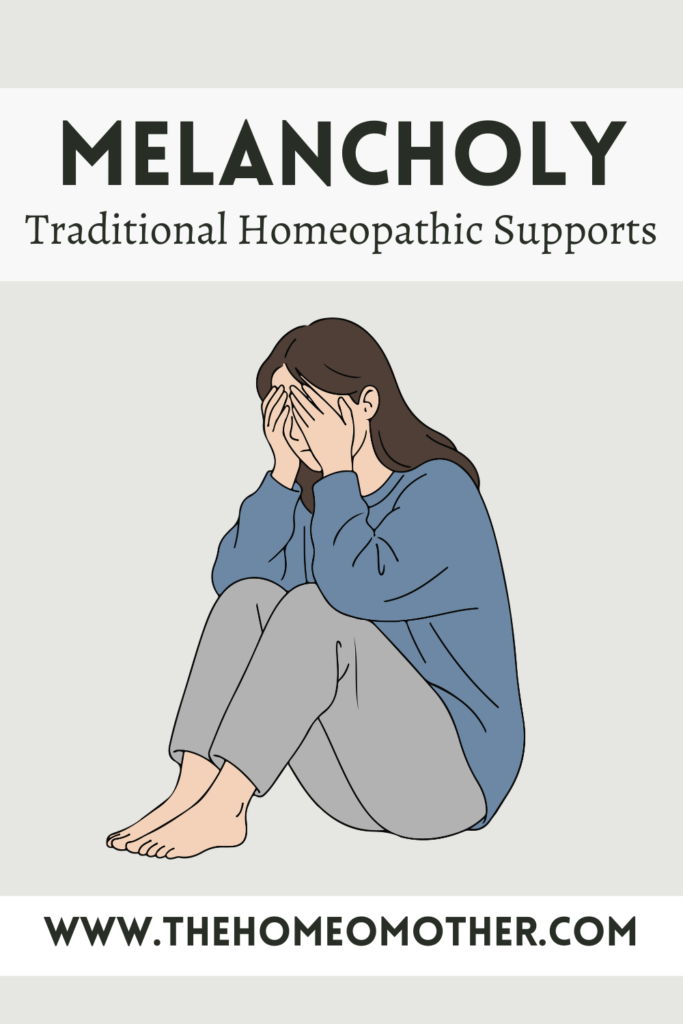
Sure, everyone may feel sad at times.
But what about when at times is more like…
Constantly.
A feeling of despair.
Or that maybe things just won’t ever get better.
Here are the homeopathic remedies traditionally associated with WITH melancholy:
Safety Note: While we explore traditional support for melancholy, if an individual is experiencing a mental health crisis, suicide ideation, or severe physical symptoms of panic, they must be evaluated by a licensed medical professional or mental health specialist immediately. For anyone feeling deeply sad, and any thoughts of self harm or suicide, please do not hesitate to reach out to the 988 SUICIDE AND CRISIS LIFELINE.
1. Nat Mur
The top remedy for chronic sadness. This person may feel very closed off, reserved, and serious. They may have a feeling of needing to cry, but can’t (or only if when they are alone). They are all about their inner circle, and it is not easy for outsiders to get to know them. Can also have issues with dry skin, constipation, and headaches (particularly from/or made worse by the sun).
2. Ignatia
Often the acute form of Nat Mur (but can also be chronic). This state commonly arises in those experiencing some form of grief, or otherwise very repressed emotions that can be felt as a tightness or blockage in the chest or lump in throat. There is often a lot of sighing. Unexpressed long term this can lead to various form of tics or twitches. This remedy can help restore emotional balance after the death of a loved one.
3. Aurum
This type is often those who are workaholics to the extent that their entire identity is around their job and financial matters. This type of deep sadness is very dark, and very deep/heavy. There can be a family history of deep sadness with inclinations towards suicide. May feel drawn towards seeking comfort in music and spirituality.
4. Conium
For those that may gradually overtime withdraw into themselves more and more, experiencing a paralysis of self. This can lead to deep sadness as they do not feel connected to others. Often associated with breast lumps or other lumps in the glands.
5. Sepia
Common in women, a deep sadness resulting from feelings of indifference or even irritation towards loved ones.
6. Kali Phos
For those who experience deep sadness from mental burnout. They may go go go and then feel the opposite swing of complete exhaustion causing a state of deep sadness.
7. Cimicifuga
A feeling of deep sadness arising from feeling caged in, yet at the same time also very clingy. Gives rise to more oscillating type state that may swing back and forth.
want to learn more about homeopathy?
The Homeo Mother Community is a private resource library & educational forum for mothers learning to navigate homeopathy at home.
I hope that you all found this informative and interesting! If you would like to stay updated on new educational resources, be sure to subscribe to my newsletter and leave a comment below.