
Homeopathic Potencies Explained | Foundational Learning of the Basics
So if you’re new to homeopathy, or maybe you’re somewhat familiar: the remedies come in potencies.
I know that is is easy to assume initially that the higher the potency, must mean the greater the effect.
Even I originally assumed that.
But that is actually not the case at all.
The best way to think about the potency scale is through the lens of the totality of symptoms.
I briefly touched on it in the prior post, but basically within homeopathy all symptoms are taken into account: physical (including things that may seem completely unrelated, like a rash and a headache), mental, emotional, dreams, dietary habits, stool, just as much as possible.
From there, the symptoms are then matched to a remedy that also contains those same symptoms, on the basis of “like cures like”.
So, all that said:
The remedies feature physical traits, mental traits, emotional traits, dreams, etc.
The remedies have within them a vast scale of healing potential ranging from more minor issues like a headache, to much deeper complex psychological disorders.
With all that now in consideration: the potency scale is based on the full magnified potential of a remedy.
So if you just have a simple headache, and the symptoms for that headache best align with the remedy Nat Mur – you would take it in a low potency as it is a physical issue.
However let’s say that you are prone to chronic depression, cannot ever really cry, are very composed/reserved, and get headaches all the time: you may need a higher potency of Nat Mur (however it is always best to start with the lower and work up).
To simplify as much as possible now:
The low potencies act on physical issues, and the higher potencies act on the mental/emotional issues.
This is why potencies like 6x and 12x are often used for organ drainage (physical issue) whereas professional homeopaths can prescribe much higher potencies such as 10M+ for more psychological based issues.
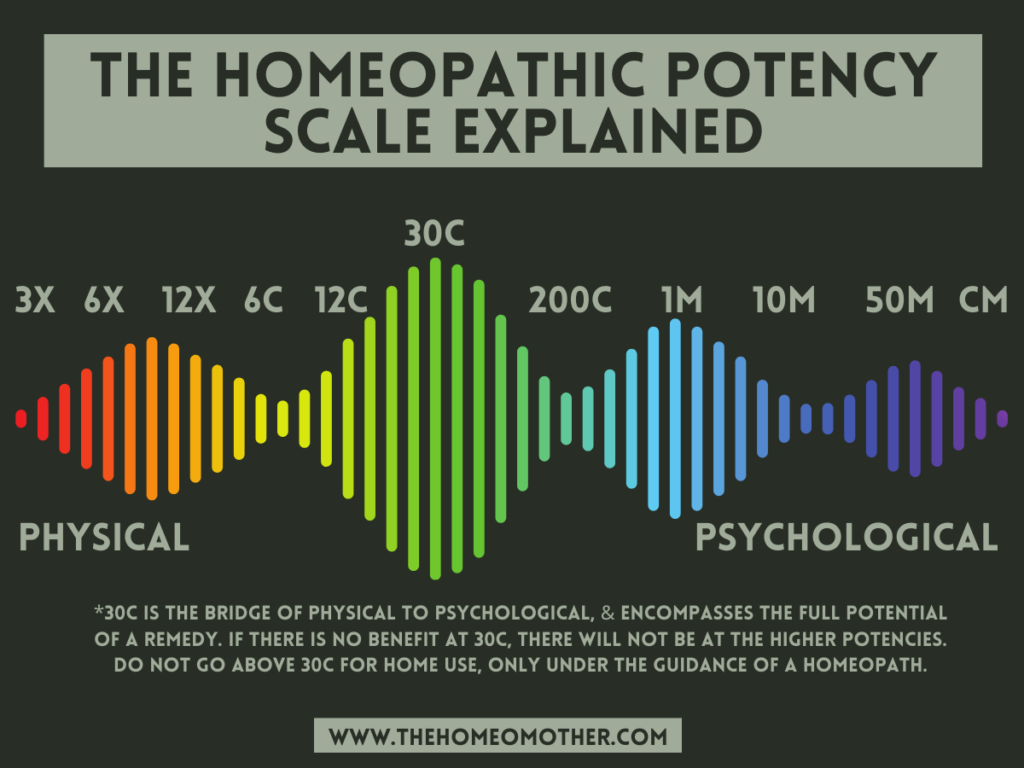
Generally speaking though, the consensus typically is to not go above 30c for home use.
30c is basically like the bridge of physical to psychological, and will encompass the full magnitude of what a remedy can do. This means that if you have the type of depression that could maybe warrant a 10M down the road, if the remedy is truly indicated, there would be noticeable benefit at 30c.
Part of the reason too to not just jump into the higher potencies of 200c and above is because what is known as a proving can occur.
Provings are an entire post within themselves, check it out here 🙂
want to learn more about homeopathy?
The Homeo Mother Community is a private resource library & educational forum for mothers learning to navigate homeopathy at home.
I hope that you all found this informative and interesting! If you would like to stay updated on new educational resources, be sure to subscribe to my newsletter and leave a comment below.

Thank you for sharing your knowledge.
You are very welcome!!